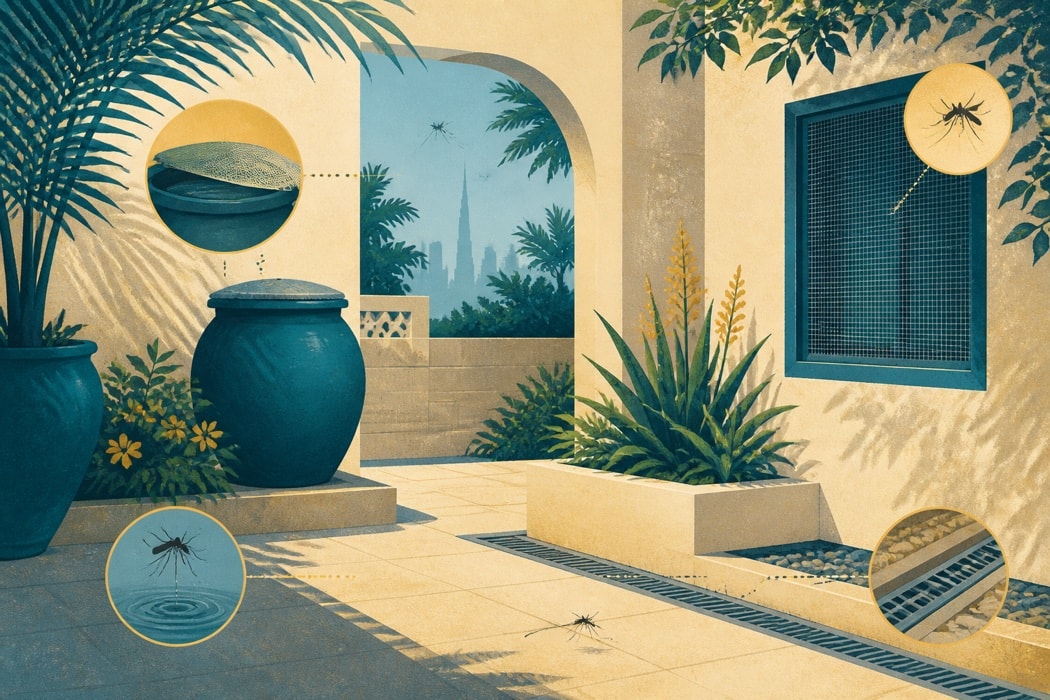
Mosquito activity is shaped by species, season, water and access to people. Around a residence, the most useful action is often a repeated survey for small collections of water rather than a one-time sweep. Balconies, courtyards, roof areas and service spaces can hold water in places that are easy to miss: beneath planters, inside a folded cover, at the base of a drain or in a container waiting to be reused.
The CDC’s household mosquito guidance recommends a weekly routine of emptying and scrubbing, turning over, covering or discarding water-holding items. Scrubbing matters because eggs can remain attached near a water line. Permanent water storage requires a close-fitting cover or a suitable mesh barrier; a loose lid that collects rain or irrigation water can create another problem.
Walk the property in a consistent order
Begin at the highest outdoor area you can access safely and work downward. Check air-conditioning condensate paths, planter trays, watering equipment, ornamental containers, buckets and refuse lids. Look at drainage grates for blockages rather than reaching into them. If a water feature or pool is managed by a building, report maintenance concerns to the responsible team instead of adding a household product.
- Empty, scrub or cover small containers every week.
- Keep gutters and surface drains free of visible debris.
- Repair or report leaking irrigation and condensate lines.
- Check window and door screens for gaps and poor fit.
- Record where adult mosquitoes rest or repeatedly enter.
Barriers and personal protection
Good screens, closed doors and well-maintained seals reduce mosquito entry. In a room where mosquitoes are repeatedly found, inspect the screen frame and gaps around air-conditioning or utility penetrations before assuming the insects are breeding indoors. Fans and air conditioning may reduce contact, but they do not replace the removal of standing water.
For personal protection, follow current public-health advice and the label of any locally registered repellent. The World Health Organization’s prevention material describes physical barriers, protective clothing and appropriate repellent use alongside elimination of breeding sites. Recommendations can differ by location, health condition and outbreak status, so official local updates take priority over generic online advice.
What not to improvise
Do not add a chemical to drinking water, a pet bowl, a water feature or a drain based on a social-media recipe. Do not mix insecticides or apply them in a way the label does not permit. Fogging without inspection may briefly reduce visible adults while leaving breeding water untouched. Larger or inaccessible water bodies require assessment by the responsible property team or an appropriately qualified professional.
From one home to a shared block
Mosquito control works best when adjoining properties and common areas are considered together. If repeated activity appears near a shared drain, landscaped zone or construction area, provide the building manager with dates, times and precise locations. Dubai Municipality describes integrated programs for disease-transmitting pests and regulates local public-health pest-control work; its official section page is the relevant starting point for local responsibilities.
For a wider inspection of building access and waste conditions, read the Dubai pest-awareness guide. For food and moisture routes indoors, compare the cockroach guide.